History of the Naples Underground
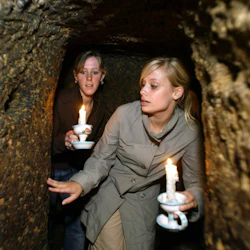
The LAES association, founded in 1988, promotes the cultural dissemination of these spaces. It organizes tours through this labyrinth of tunnels and cisterns that form a true 'negative city'. This underground structure faithfully reflects the topography of the surface city, offering a unique glimpse into Neapolitan history. Routes often include Roman cisterns and medieval tunnels.
Contrary to urban myths, these are real civil and military structures. Guides emphasize respect for ancient archaeological stratifications. These cavities served as reservoirs, shelters, and secret passages during conflict periods, constituting tangible heritage distinct from fantasized legends.
The historical complexity of Naples is read underground as well as on the surface. Each tunnel tells an era, from the Greeks to the Bourbons. The scientific approach of LAES allows separating archaeological facts from popular narratives, guaranteeing a rigorous and immersive educational experience for all visitors curious about history.
Key Differences: Metro vs. Underground
It is crucial not to confuse the Underground with the current metro network. Line 1, nicknamed 'Metro dell'Arte', is a modern public transport system. Its stations, such as Toledo elected the most beautiful in Europe by The Daily Telegraph, house contemporary installations but do not offer historical guided tours.
Metro works were slowed down by the Irpinia earthquake of 1980 and financial problems. In contrast, Underground tours are structured tourist activities. They require prior booking and supervision by professionals, unlike free access to metro stations open to daily travelers. Check time slot availability and accessibility conditions before booking.
The metro serves to move quickly through the modern city. The Underground offers a contemplative pause in past times. Although some routes may cross ancient remains discovered during metro excavations, the experience remains fundamentally different: one is utilitarian and artistic, the other is purely historical and exploratory.
Practical Info & Accessibility
The official meeting point is located at Piazza Trieste e Trento, opposite the Royal Palace. The Bar Gambrinus serves as a clear visual landmark for participants. Located near Galleria Umberto I and the Teatro San Carlo, this central location facilitates access from the historic heart, although it is heavily frequented.
Physical constraints are real: stairs, narrow passages, and potential humidity. Never claim the tour is suitable for people with reduced mobility without official verification per product. It is imperative to consult the specific conditions of each operator, as accessibility varies considerably depending on the routes proposed in these historical undergrounds.
For children, the tour is generally possible but requires increased vigilance. Check the minimum age and safety conditions with the chosen operator. Closed, non-slip shoes are mandatory due to uneven floors. Also bring an extra layer if you fear the cold in the depths.